Wyoming Labor Force Trends
October 2026 | Volume 63, No. 10
Click Here for PDF
Return to Table of Contents
Employment and Wages of the Trades in Natrona County
by: Matthew Halama, Senior Economist
Wyoming has struggled with youth leaving the state in search of better economic opportunity. Recent news articles have highlighted if jobs at data centers could stop young adults from leaving Wyoming (Jean, 2026), or how there aren’t enough workers to fill new jobs in Wyoming (Shosh, 2026). Could employment in trades occupations — electrical, mechanical (HVAC), and plumbing — help retain young Wyoming workers? This article analyzes the average annual wages of those individuals employed in those trades occupations, specifically in Natrona County, Wyoming.
The research in this article was prepared by linking administrative wage data to county-level license data supplied to the Research & Planning (R&P) section of the Wyoming Department of Workforce Services by Natrona County. Previous articles have forecasted job openings in the trades through long-term projections, or used Occupational Employment and Wage Statistics (OEWS) estimates to show employment and wages in the trades. The reliance of survey data is beneficial if administrative data are unobtainable. One drawback is that survey data focuses on the aggregate, in this case, the wages of all electricians, all mechanics (HVAC), or all plumbers. By combining administrative data from the state and county, R&P is able to examine trade data by the level of expertise (i.e. apprentice, journeyman, or master).
This study provides new insights into the average annual wages of those working in electrical, mechanical, and plumbing trades. The research could be highlighted by guidance counselors in schools to show good paying jobs can be found in the trades here in Wyoming. Businesses that operate in the trades could partner with local high schools to promote apprenticeships. This study could lead to acquiring data from other counties to show wage data. This article is divided into three parts. The first part discusses the methodology, namely where the data came from, and how they were collected. The second section deals with the results of the data analysis, while the third part presents some conclusions.
Methodology
R&P was provided a list of individuals from the years 2022-2025 that filled out a contractor license application. The variables included the applicant name (labeled applicant_name), licensee first name (labeled licensee_first_name), middle name (labeled middle_name), last name (labeled last_name), suffix (labeled suffix), record number (labeled record_number), record status (labeled record_status), license expiration licensee (labeled license_expiration_licensee), licensee DBA (labeled licensee_DBA), record (i.e contractors or license) (labeled record), type (i.e. electrical, mechanical, or plumbing) (labeled as type), and level (i.e. apprentice, journeyman, or master) (labeled as level). Apprentice is defined as an entry-level worker who has insufficient qualifications to work independently and is registered with the state while learning the trade. During that time, an apprentice must work under the direct supervision of a licensed journeyman or master tradesperson. Journeyman is a fully qualified, licensed professional who has completed the required apprenticeship hours and passed a state certification exam. A journeyman can work independently without supervision and can train and supervise apprentices. A master is the highest level of licensing and expertise in the trade, requiring extensive industry experience beyond a journeyman license.
The enhanced quarterly unemployment insurance (EQUI) database relied on the following variables: Unemployment Insurance (labeled UI) number, federal employment insurance number (FEIN) number (labeled fed), legal name of the business (labeled legal name), trade name of the business (labeled trade name), and year.
The driver’s license database from the Wyoming Department of Transportation relied on the following variables: ssn, first name, middle name, and last name. R&P collects and maintains quarterly wage record data through the Unemployment Insurance (UI) system from 1992 to present, which includes approximately 92% of Wyoming jobs. The variables used from the wage record database are social security number (ssn), year, UI number, and wages.
In order to create the tables needed for this research, it was necessary to create a new variable from the contractor list named year. This was from the existing variable license expiration licensee, only it contained the year in which the license was good for. Doing this allowed R&P to add the UI number and legal name from the EQUI database to the contractor list by legal name and year. Next, the license_DBA variable was conformed to match the legal name variable in the EQUI database due to incorrect spelling or missing LLC or INC etc. There were 143 businesses that had to be updated to conform to the EQUI database. Some businesses in the contractor list had apostrophes or other errors which couldn’t be matched using the EQUI database and had to be corrected by inserting the UI number. Thirteen businesses had to be corrected using this technique. Following these two steps, there were businesses in the contractor list that couldn’t be matched to the EQUI database or had NULL values. These businesses were classified as non-liable meaning they had no employees except the owner. All other businesses in the contractor list were categorized as liable. From there the only selection were those that were in electrical, mechanical, or plumbing, and were considered liable with a UI number. This table was named #contractor5.
The next step was utilizing the Wage Records database to get the year, ssn, UI number, and summing the wages to create a new variable named annual wages. The filter for this table was that the year selected was 2022 or greater and had a UI number from the previous table that had only those in electrical, mechanical, or plumbing and were considered liable with a UI number. This new table labeled annualwages added the following variables from the driver’s license database: first and last name, ssn as ssncheck to make sure that the ssn numbers matched. This new table was titled annualwages1.
Annualwages1 and #contractor5 were joined together by multiple variables including year, UI number, first name, and last name. Before the creation of the table named #contractor6 licensee_first_name from #contractor5 was updated so it matched the first name from #annualwages1 which subsequently came from the driver’s license file. One-hundred and sixty names had to be updated to match records from the driver’s license database. The table was named #contractor6 and then the #contractor6 table filtered out ssns that were NULL which was named #contractor7.
This same process was done for those that already had a legal name that matched the EQUI database. Within this table, 10 names had to be updated to match the driver’s license database in order to get annual wages. This table was labeled #contractor8. The tables #contractor7 and #contractor8 were then joined together where the variable record status was marked complete. The final table was named #finishedcontractor and table was used for the results section. There were 1,595 licensee applications provided by Natrona County between 2022-2025 for electrical, mechanical, and plumbing. Of those, 935 licensed workers were found in wage records. Explanations for the remaining 660 licensed workers not found in the wage record database range from non-working retirees keeping their license active to licensees that run non-liable businesses and wouldn’t have records in the wage record database.
Results
Wages for journeyman and masters in the trades were noticeably higher than Natrona County's 2025 average annual wage of $63,373, according to the Quarterly Census of Employment and Wages.
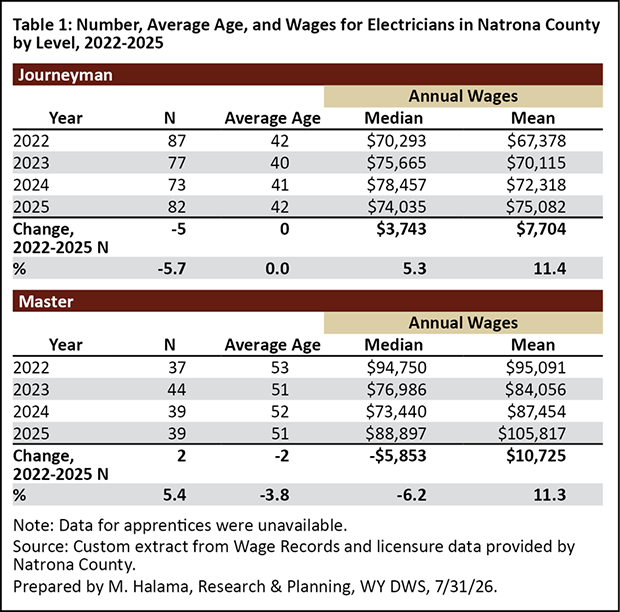
The average annual wage of journeyman electricians in Natrona County was $67,378, which steadily increased to $75,082 by 2025 — an increase of $7,704, or 11.4%. There were 87 journeyman electricians in 2022 and 82 in 2025 (see Table 1). The average age of journeyman electricians hovered between 40 and 42 years between 2022 and 2025. Master electricians had an annual average wage of $95,091 in 2022, which increased to $105,817 in 2025 ($10,725, or 11.3%). There were 37 master electricians in 2022, which increased to 39 in 2025. The average age of master electricians was 51-53 years between 2022 and 2025. Apprentice electrical licensee data for Natrona County workers were unavailable.
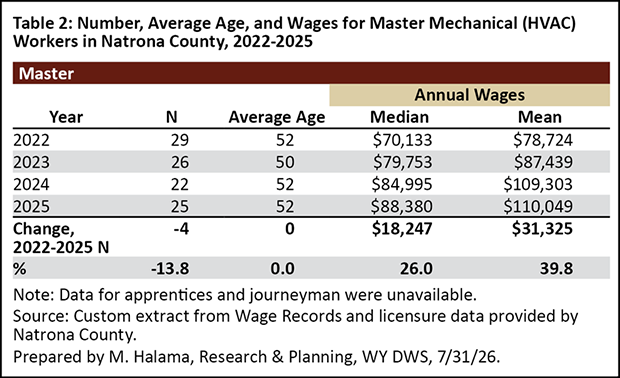
Master mechanical (HVAC) workers had an average annual wage of $78,724 in 2022, which increased to $110,049 in 2025 ($31,325, or 39.8%; see Table 2). There were 29 master mechanical workers in 2022 and 25 in 2025. The average age of master HVAC workers was between 50 and 52. Apprentice and journeyman mechanical licensee data for Natrona County workers were unavailable.
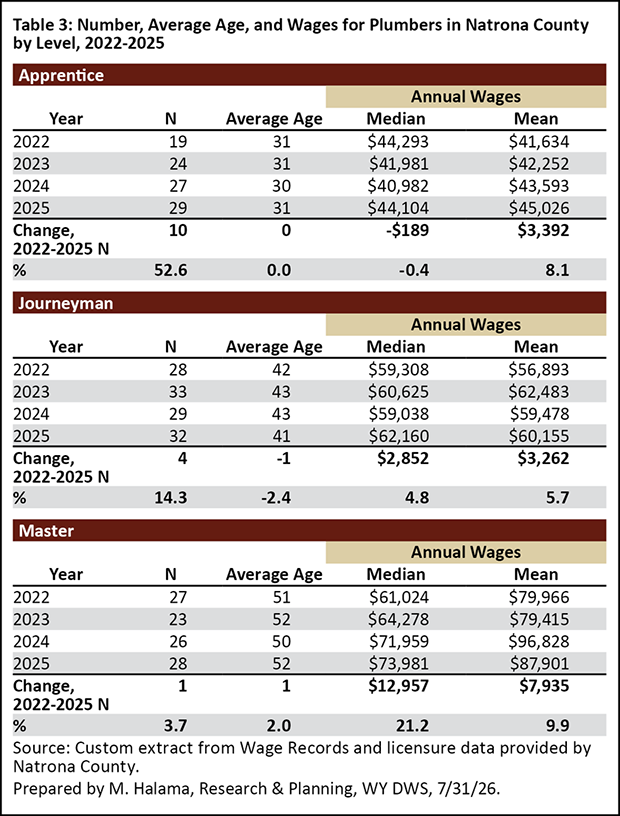
Finally, apprentice level plumbers had an average annual wage of $41,634 in 2022, increasing to $45,026 in 2025 ($3,392, or 8.1%; see Table 3). There were 19 apprentice plumbers in 2022 and 29 in 2025. The average age of apprentice level plumbers was 30-31. The average annual wages of journeyman plumbers in 2022 was $56,893, which increased to $60,155 in 2025 ($3,262, or 5.7%). There were 28 journeyman plumbers in 2022 and 32 in 2025. Journeyman plumbers had an average age between 41 and 43. Master level plumbers had an annual average wage of $79,966 in 2022, increasing to $87,901 in 2025, ($7,935, or 9.9%). There were 27 master plumbers in 2022 and 28 in 2025. The average age of master level plumbers was 51-52.
Conclusions
This article was written to serve multiple purposes. First, R&P sought licensee data in different trades from Natrona County to match with Wage Records. By linking these data, R&P was able to use administrative data to show the number of tradesmen per year, average annual wages of those in the trades (electricians, HVAC, and plumbers) by level (apprentice, journeyman, master) and year, the average age by level and year, and changes from 2022-2025.
In conjunction with obtaining and presenting administrative wage data on the trades, this article may encourage those who feel that college may not be an option or those wanting to leave the state for employment opportunities to consider a career in the trades. Past research articles have focused on average annual wages by educational attainment (i.e., high school graduates against various degree holders). The issue with this approach is twofold; first is that those in the trades have specialized training that would set them apart from those with a high school graduate like any degree holder would. Including the average annual wages of high school graduates with high school graduates that are employed in the trades wouldn’t provide accurate average annual wage information. Also, separating average annual wages from those in the trades and high school graduates from an overall high school graduates more than likely would show those in the trades having a higher average annual wage than the overall, while those not in the trades may have a lower average annual wage than the overall.
This research article was conceived as an entry point into potential future research articles by merging trades information at the county level with statewide wage record data. R&P appreciates the assistance from Natrona County in providing a list of licensees in the trades. Some limitations include not having apprentice level data for electricians, and apprentice and journeyman level data for mechanical trades. Also, R&P isn’t aware of the formatting of other county license applications, but it would be beneficial for research purposes if it were streamlined between counties. Possible suggestions would be to include the UI number of the business and having the applicant fill out information that would be on their drivers license to reduce the amount of time cleaning the data.
Future research may include replicating this study to include all counties to be able to provide average annual wages by trade and their respective level, county, and year. This would also provide a distinction between rural and urban areas within the state to see differences in average annual wages within the trades.
References
Jean, R. (2026, July 10). Could data center jobs stop young adults from leaving Wyoming? Cowboy State Daily. Retrieved September 9, 2026, from https://tinyurl.com/7sjnxhj3
Shosh, C. (2026, July 27). New data forecasts not enough workers to fill new Wyoming jobs. WyoFile. Retrieved September 8, 2026, from https://tinyurl.com/mstsd644
U.S. Census Bureau. (n.d.). S2001: Earnings in the past 12 months (in 2024 inflation-adjusted dollars). Retrieved September 9, 2026, from https://data.census.gov/table/ACSST5Y2024.S200
 Hire Wyo