Wyoming Labor Force Trends
June 2026 | Volume 63, No. 6
Click Here for PDF
Return to Table of Contents
2025Q3 Quarterly Update: Average Monthly Employment Decreases in Third Quarter
by: Michael Moore, Research Supervisor
This article provides an overview of Wyoming’s employment and wages in third quarter 2025 at the county and industry levels, in order to identify areas of over-the-year job losses and growth.
This article provides an overview of Wyoming’s employment and wages in third quarter 2025 at the county and industry levels, in order to identify areas of over-the-year job losses and growth.
In third quarter 2025 (2025Q3) after 17 consecutive quarters of over-the-year job growth, Wyoming's average monthly employed decreased for the first time since the Covid-19 pandemic (see Figure 1 and Figure 2). Wyoming lost more than 1,300 jobs from 2024Q3 to 2025Q3, a decrease of 0.5% (see Table 1). Despite moderate over-the-year job losses, total payroll in the state increased by $66.1 million, or 1.5%.
Wyoming job losses often occur during periods of economic downturn, which the Research & Planning (R&P) section of the Wyoming Department of Workforce Services has defined an economic downturn as a period of at least two consecutive quarters of over-the-year decreases in average monthly employment and total wages based on data from the Quarterly Census of Employment and Wages (QCEW).
Since 2009, Wyoming has endured three such economic downturns: 2009Q1 to 2010Q1, 2015Q2 to 2016Q4, and 2020Q2 to 2021Q1 (see Figure 2). While each downturn had its own unique circumstances, declining energy prices preceded all three (Moore, 2021). These periods of downturn are indicated by shaded boxes in the figures presented with this article.
Even with over-the-year job losses, 2025Q3 is unlikely to mark the start of a new economic downturn for Wyoming. During each previous downturn, declines in employment and total wages began in the same quarter, which did not happen in 2025Q3, as total wages increased. Preliminary data from 2025Q4 indicate this continued, with slower job losses but increases in total wages. In addition, estimates from the Current Employment Statistics program indicate job gains in Wyoming during the first four months of 2026 (Bullard, 2026).
Each prior downturn began following a significant event: the U.S. Great Recession in 2007, large scale layoffs and job losses in Wyoming's energy sector in 2015, and the Covid-19 pandemic in 2020. Such an event has not happened nationally or locally prior to the most recent job losses.
Over-the-year job losses were not unique to Wyoming in 2025Q3. Data from the QCEW also show job losses in neighboring states Colorado (-0.5%) and Montana (-0.1%), with minimal job growth in Nebraska (0.1%) and South Dakota (0.4%; Moore, in press). Nationally, average monthly employment increased by 0.3% over the year.
This article looks at quarterly employment and wages at the county and industry levels for 2025Q3 in Wyoming, in order to illustrate where job losses and gains occurred. The data discussed in this article are from the QCEW and Wyoming data for 2025Q3 are available at https://doe.state.wy.us/LMI/25Q3_QCEW/toc.htm.
2025Q3 Jobs and Wages
Wyoming’s average monthly employment in 2025Q3 was 288,400, a loss of 1,320 jobs (-0.5%) compared to 2024Q3 (see Table 2). The state had $4.5 billion in total wages, up $66.1 million (1.5%) over the year. Wyoming's average weekly wage increased from $1,178 to $1,201 ($23, or 2.0%).
Industry
Industries are organized by the North American Industry Classification System (NAICS). A sample of the NAICS hierarchal structure for construction (NAICS 23) can be found in Box 1. This section discusses statewide employment and wages at the sector (or two-digit NAICS) level, with further discussion on the more detailed subsector (three-digit NAICS) and industry (four-digit NAICS) for certain sectors.
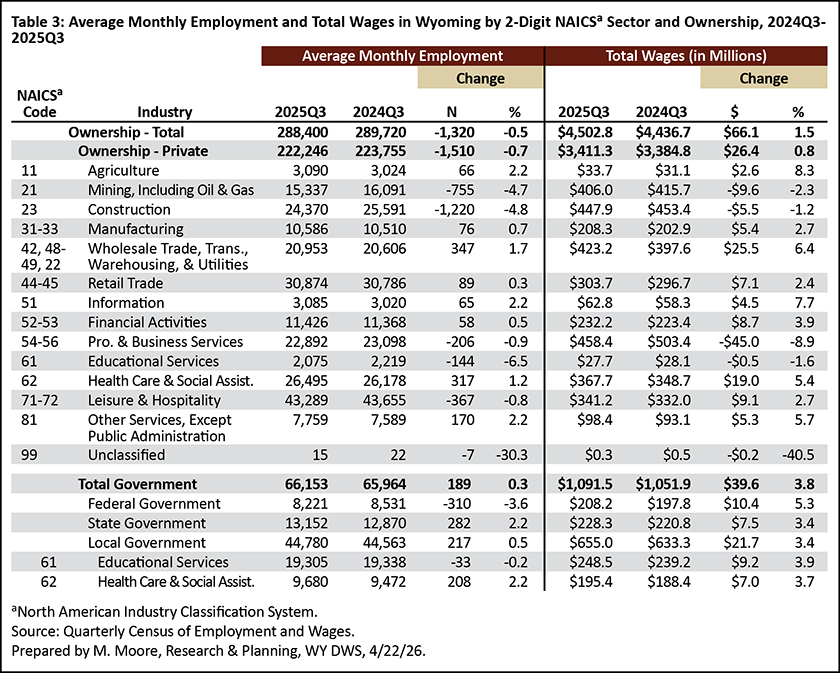
Substantial over-the-year job losses were seen in construction (-1,220, or -4.8%) and mining, including oil & gas (-755, or -4.7%; see Table 3). Other industries that lost jobs included leisure & hospitality (-367, or -0.8%), professional & business services (-206, or -0.9%), and educational services (-144, or -6.5%). Over-the-year job gains were seen in health care & social assistance (317, or 1.2%) and other services, except public administration (170, or 2.2%). Wholesale trade, transportation, & utilities showed an over-the-year increase of 347 jobs (1.7%), although many of those were due to non-economic code changes. Total government increased by 189 jobs (0.3%), with increases in state (282, or 2.2%) and local (217, or 0.5%) government and job losses in federal government (-310, or -3.6%).
Wyoming employers paid $4.5 billion in total wages in 2025Q3, an over-the-year increase of $66.1 million, or 1.5%. Over-the-year increases in total wages were seen in industries such as health care & social assistance ($19.0 million, or 5.4%), leisure & hospitality ($9.1 million, or 2.7%), and financial activities ($8.7 million, or 3.9%). The $25.5 million increase in wholesale trade, transportation, & utilities was partially due in large part to the aforementioned non-economic code changes. Substantial decreases in total wages were seen in professional & business services (-$45.0 million, or -8.9%) and mining, including oil & gas (-$9.6 million, or -2.3%).
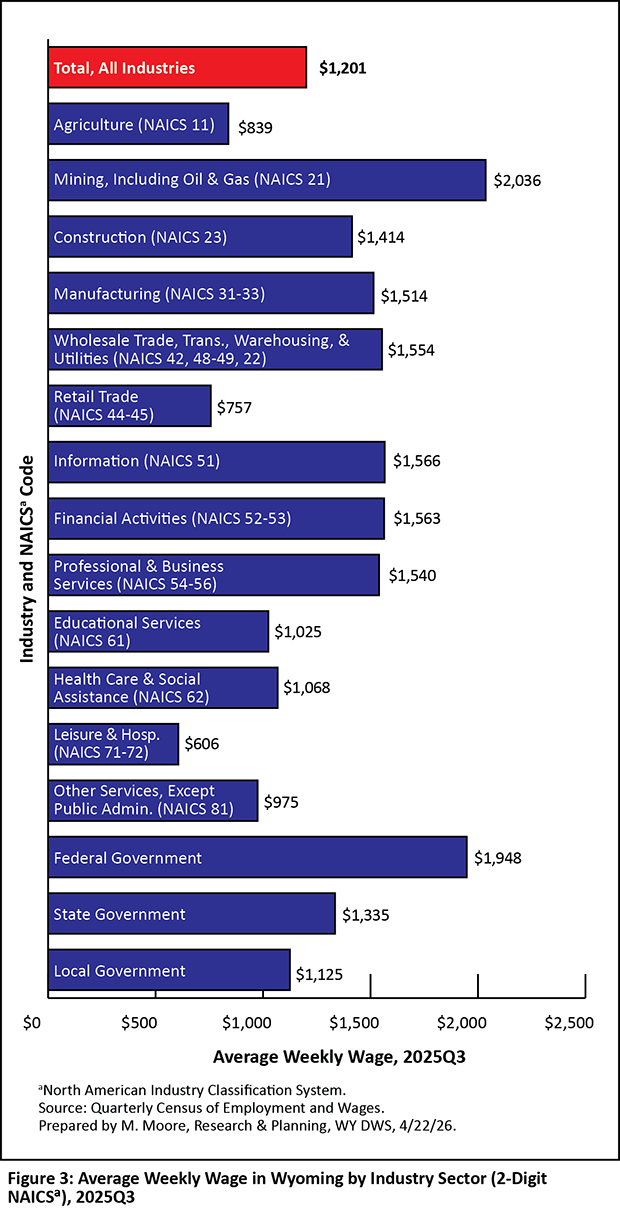
Wyoming's average weekly wage in 2025Q3 was $1,201 (see Figure 3). The highest average wages were seen in mining, including oil & gas ($2,036); federal government ($1,948); information ($1,566); financial activities ($1,563); wholesale trade, transportation, & utilities ($1,554); professional & business services ($1,540); and manufacturing ($1,514). The industries with the lowest wages were leisure & hospitality ($606), retail trade ($757), and agriculture, forestry, fishing, & hunting ($839).
County
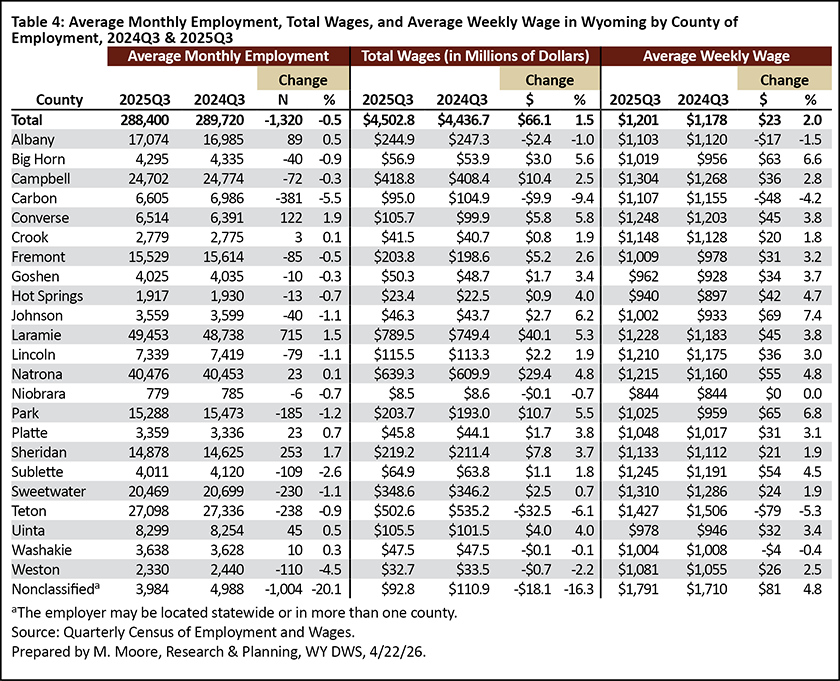
Over-the-year job growth occurred in nine of Wyoming's 23 counties, while job losses were seen in 14 (see Table 4). Laramie County added the greatest number of jobs (715, or 1.5%), followed by Sheridan (253, or 1.7%), Converse (122, or 1.9%), and Albany (89, or 0.5%) counties. The largest job losses belonged to a nonclassified county (employers located statewide or in more than one county) with 1,004 fewer jobs, or 20.1%. The counties with the greatest job losses included Carbon (-381, or -5.5%), Teton (-238, or -0.9%), Sweetwater (-230, or -1.1%), and Park (-185, or -1.2%).
Laramie County added the largest number of jobs (715, or 1.5%) and total wages ($40.1 million, or 5.3%). Teton County lost 238 jobs (-0.9%) and also saw total wages decrease by $32.5 million (-6.1%). In some cases, the counties with the largest increases in total wages were also those with the greatest job losses. For example, Park County lost 185 jobs (-1.2%) but added $10.7 million (5.5%) in total wages. Campbell County also lost jobs (-72, or -0.3%) while increasing total wages ($10.4 million, or 2.5%).
Teton County had the highest average weekly wage in 2025Q3 ($1,427), due in part to especially high wages in industries like management of companies & enterprises, finance & insurance, and information (Research & Planning, 2026). Many of the other counties with high wages were those with relatively large numbers of mining-related jobs, such as Sweetwater ($1,310), Campbell ($1,304), Converse ($1,248), and Sublette ($1,245). The counties with the lowest average weekly wages included Niobrara ($844), Hot Springs ($940), and Goshen ($962).
A Closer Look
Table 5 shows more specific data on where job losses occurred by subsector (three-digit NAICS) and county. As previously mentioned, the greatest job losses were seen in Wyoming’s construction sector (-1,220 jobs, or -4.8%). Many of those job losses (-815) were seen in a nonclassified county, indicating that those jobs were with large, statewide employers. Large job losses in heavy & civil engineering construction were found in Natrona (-346, or -30.1%), Carbon (-284, or -70.9%), and Sweetwater (-143, or -24.8%) counties, likely indicating the completion of large construction projects. Mining-related job losses were seen in mining, except oil & gas (which includes coal mining) in Campbell County (-229, or -7.1%), support activities for mining in Laramie County (-143, or -25.0%), and oil & gas extraction in Natrona County (-122, or -30.7%).
In contrast, Table 6 shows greatest employment increases by subsector (three-digit NAICS) and county of employment. Job growth in Laramie County was spread out across many industry subsectors, including specialty trade contractors (413, or 19.2%), food & beverage retailers (124, or 21.4%), construction of buildings (99, or 17.4%), and local government educational services (92, or 2.7%). Campbell County saw job growth in specialty trade contractors (111, or 8.9%) and food services & drinking places (88, or 4.7%).
Conclusion
In 2025Q3, Wyoming's average monthly employment declined from prior-year levels for the first time since the Covid-19 pandemic, as the state lost more than 1,300 jobs. However, several factors suggest that 2025Q3 was not likely the start of a new economic downturn for Wyoming. Despite job losses, total wages increased by $66.1 million, and other program estimates indicate moderate over-the-year job gains during the first two months of 2026.
Preliminary QCEW data for 2025Q4 indicate more of the same: moderate over-the-year job losses with increases in total wages. Data for 2025Q4 will be published in August 2026.
References
Bullard, D. (2026, April). Wyoming unemployment rate falls to 3.5% in April 2026. Research & Planning, Wyoming Department of Workforce Services. Retrieved June 10, 2026, from https://doe.state.wy.us/LMI/2026_04_news.pdf
Moore, M. (2021, January). 2020Q2 quarterly update: Covid-19 pandemic forces historic job losses in 2020Q2. Wyoming Labor Force Trends, 58(1). Research & Planning, Wyoming Department of Workforce Services. Retrieved April 24, 2026, from https://doe.state.wy.us/LMI/trends/0121/0121.pdf
Moore, M. (In press). Chapter 2: Wyoming shows first signs of job losses in 2025. 2026 Wyoming Workforce Annual Report. Research & Planning, Wyoming Department of Workforce Services.
Research & Planning. (2026, April). Wyoming Quarterly Census of Employment and Wages — Teton County. Retrieved October April 24, 2026, from https://doe.state.wy.us/LMI/25Q3_QCEW/t24.htm
 Hire Wyo