Wyoming Department of Workforce Services Logo

Wyoming Department of Workforce Services

Research & Planning
444 W. Collins Dr.
Suite 3100
Casper, WY 82601
(307) 473-3807

Email link

"Labor Market Information (LMI) is an applied science; it is the systematic collection and analysis of data which describes and predicts the relationship between labor demand and supply." The States' Labor Market Information Review, ICESA, 1995, p. 7.

The Federal Government reserves a paid-up, nonexclusive and irrevocable license to reproduce, publish or otherwise use, and to authorize others to use for federal purposes: i) the copyright in all products developed under the grant, including a subgrant or contract under the grant or subgrant; and ii) any rights of copyright to which the recipient, subrecipient or a contractor purchases ownership under an award (including but not limited to curricula, training models, technical assistance products, and any related materials). Such uses include, but are not limited to, the right to modify and distribute such products worldwide by any means, electronically or otherwise. Federal funds may not be used to pay any royalty or license fee for use of a copyrighted work, or the cost of acquiring by purchase a copyright in a work, where the Department has a license or rights of free use in such work, although they may be used to pay costs for obtaining a copy which is limited to the developer/seller costs of copying and shipping. If revenues are generated through selling products developed with grant funds, including intellectual property, these revenues are program income. Program income must be used in accordance with the provisions of this grant award and 2 CFR 200.307.

Wyoming Labor Force Trends

February 2026 | Volume 63, No. 2


Click Here for PDF

Return to Table of Contents


Long-Term Occupational Projections by Sub-State Region

Article | Tables and Figures

by: Laura Yetter, Senior Economist


The Research & Planning (R&P) section of the Wyoming Department of Workforce Services recently published long-term sub-state occupational projections, which are available at http://doe.state.wy.us/LMI/projections.htm. This article contains just a sample of the type of data available in these projections.

Sub-state occupational projections contain a wealth of data that can help jobseekers, employers, and training providers understand workforce trends and needs and help prepare for the future.

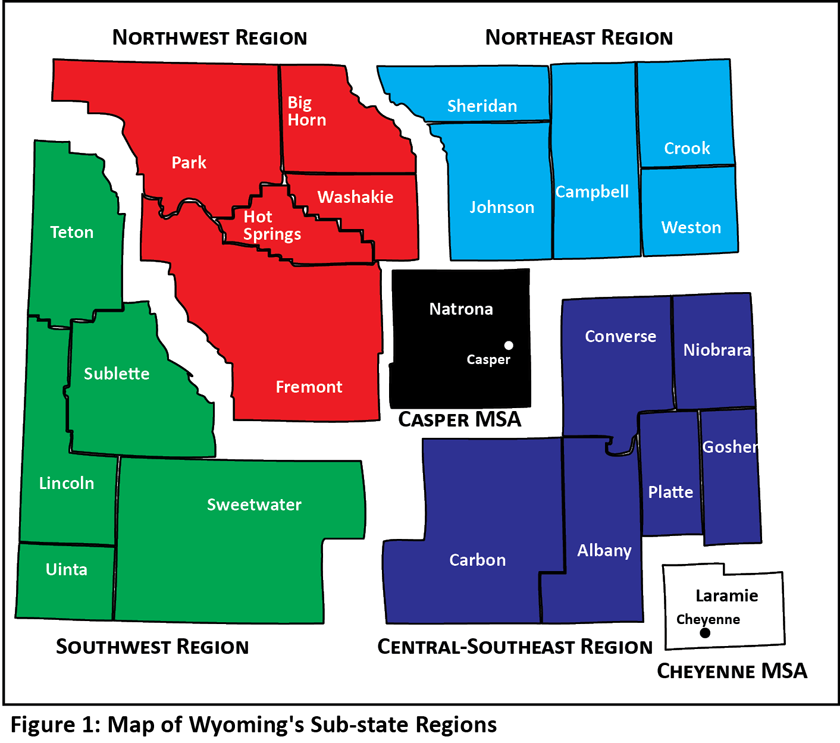
For the purposes of projections, Wyoming is divided into six sub-state regions: Casper metropolitan statistical area (MSA), Cheyenne MSA, central-southeast, northeast, northwest, and southwest. The counties that make up each sub-state region are illustrated in Figure 1.

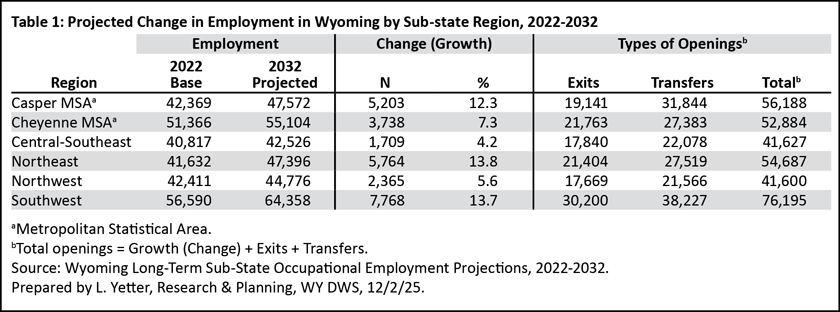
Table 1 shows the number of projected job openings for each sub-state region. Change or growth refers to new jobs. Openings due to exits refers to jobs created when people leave the Wyoming labor force. Openings due to transfers occur when an individual changes careers. Finally, total openings refers to the sum of openings due to growth, exits, and transfers. The southwest region is projected to have the greatest number of total projected openings (76,195), followed by the Casper MSA (56,188) and northeast region (54,687).

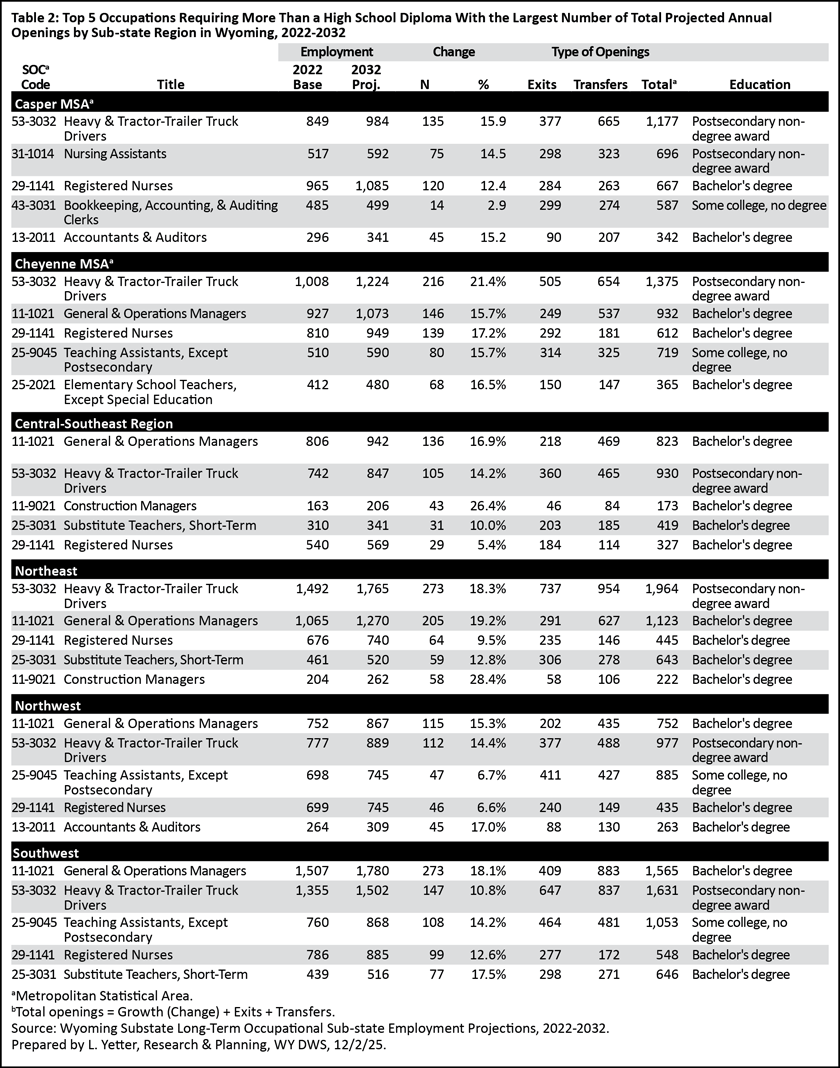
Table 2 shows the top five occupations requiring at least some postsecondary education by total projected openings for three of Wyoming's sub-state regions: Casper MSA, Cheyenne MSA, and Southwest. Many of the same occupations appear in the top five for each region. Heavy & tractor-trailer truck drivers has the greatest total projected openings for the Casper MSA (1,294) the Cheyenne MSA (1,375), and the southwest region (1,631). The Casper MSA top five also includes nursing assistants (789) and registered nurses (706). The top five for the southwest region is unique in that it includes substitute teachers, short-term (646).