Wyoming Long-Term Industry and Occupational Employment Projections, 2024-2034
Return to 2024-2034 projections home.
Published June 2026.
New Long-Term Projections Show Continued Job Growth
by: Laura Yetter, Senior Economist
The latest long-term industry and occupational employment projections show continued growth across most industries and many occupations over the next 10 years. These projections were completed during a period that included moderate job losses; as such, projected job growth slowed somewhat compared to earlier long-term projections. Never the less, Wyoming's overall employment is projected to grow by nearly 10% over the next 10 years.
Wyoming is projected to add nearly 28,000 new jobs over the next 10 years, according to the new long-term industry and occupational employment projections for Wyoming from 2024 to 2034 from the Research & Planning (R&P) section of the Wyoming Department of Workforce Services. This marks an increase of 9.9% from 2024 to 2034, and equates to Wyoming adding almost 2,800 jobs each year during that 10-year period. The full projections discussed in this article are available by clicking here.
R&P publishes long-term industry and occupational projections for Wyoming each year. Long-term statewide projections are published during the even years, and projections for Wyoming’s sub-state regions are published during the odd years. Projections are based on historic trends of how employment levels respond to market conditions such as natural gas and oil prices, building permits, mortgage rates and coal production, both within Wyoming and throughout the United States. Projections cannot account for large-scale disruptions, such as the national Great Recession and the Covid-19 pandemic.
Annual data from 1990 to 2024 were used in the creation of the 2024-2034 projections, with recent years given more weight in the projection analysis. The last few years of these projections reflect substantial job growth, but at a slightly slower rate compared to the previous projections for 2022-2032.
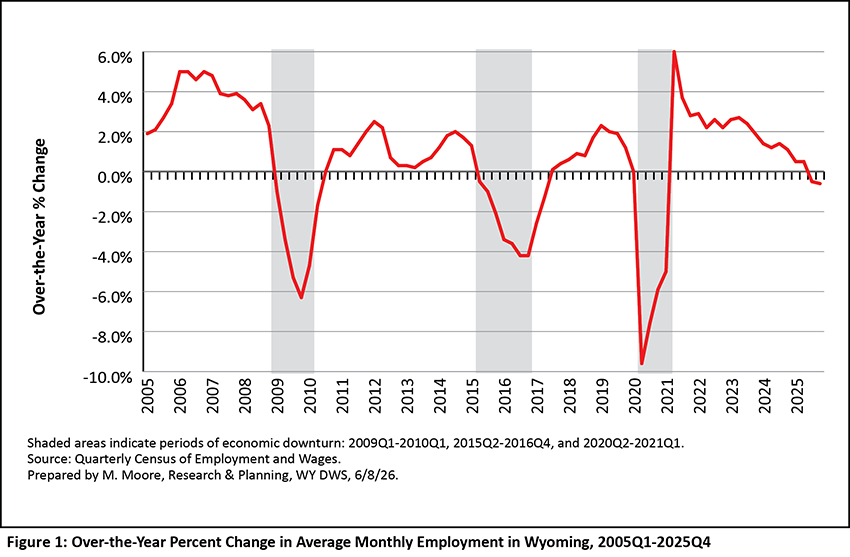
Over the last 20 years, Wyoming has experienced three periods of economic downturn, all of which were preceded by declining energy prices. An economic downturn is defined by R&P as a period of at least two consecutive quarters of over-the-year decrease in average monthly employment and total wages based on data from the Quarterly Census of Employment and Wages (QCEW).
The first of these downturns lasted from first quarter 2009 to first quarter 2010 (2009Q1-2010Q1) and began during the national Great Recession. The second lasted from 2015Q2 to 2016Q4, and was primarily driven by the collapse of energy prices and the demand for resources such as coal and oil; therefore, this downturn was more unique to Wyoming, and occurred during a period of national growth. The most recent downturn lasted from 2020Q2 to 2021Q1 during the Covid-19 pandemic. These three downturns all represent examples for which projections cannot account. As shown in Figure 1, Wyoming's average monthly employment increased from prior-year levels for 17 consecutive quarters after the pandemic. However, this growth trended downward the last couple years and during 2025Q3 and 2025Q4, Wyoming lost jobs. Consequently, the 2024-2034 long-term projections indicate slower growth.
Industry Projections
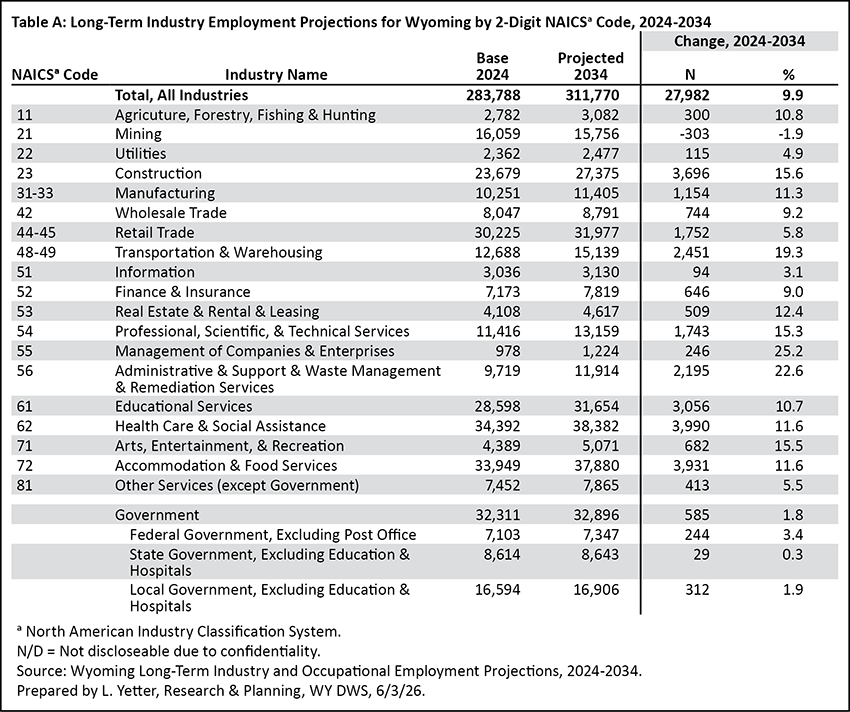
Industries are classified according to the North American Industry Classification System, (NAICS). The industry projections are developed at the three-digit NAICS subsector level and then summed to the two-digit major industries shown in Table A. The full industry projections table with three-digit NAICS subsectors can be found in Table 1.
Long-term industry projections indicate that Wyoming’s employment is expected to increase from 283,788 in 2024 to 311,770 in 2034, an increase of 27,982 jobs, or 9.9%. Health care & social assistance is projected to see the greatest growth (3,990 jobs, or 11.6%); this industry includes ambulatory health care services, hospitals, nursing & residential care facilities, and social assistance. Other industries projected to see job growth include accommodation & food services (3,931, or 11.6%), construction (3,696, or 15.6%), and educational services (3,056, or 10.7%). The only industry projected to lose jobs over the next 10 years is mining, including oil & gas (-303, or -1.9%).
Occupational Projections
Staffing patterns from the Occupational Employment and Wage Statistics (OEWS) program are used for occupational projections. These staffing patterns are done in partnership with the U.S. Bureau of Labor Statistics (BLS) to produce the OEWS survey twice a year. This survey collects wage and salary information for all full- and part-time Wyoming workers in nonfarm industries, producing occupational estimates by metropolitan, non-metropolitan area, industry, and ownership. These estimates are then combined with the industry projections in the Projections Managing Partnership software program to cross-reference industry and occupational codes by the occupational job projection. Occupations are classified using the Standard Occupational Classification (SOC) system. The 2024-2034 long-term projections include occupational projections tables for each two-digit major group and by educational requirement. Projections for the two-digit major occupational groups are available by clicking here.
In addition to growth or decline, long-term occupational projections also take into consideration anticipated openings due to workers leaving the workforce (exits) or changing occupations (transfers) from 2024Q2 to 2034Q2. Total openings are the sum of projected growth or decline in the number of jobs in a given occupation, plus the number of exits and transfers.
The newest long-term occupational projections show Wyoming employment increasing by 29,342 jobs. This is slightly higher than the projected growth at the industry level, due to differences in the methodology. One key difference is that the industry projections are limited to wage and salary jobs, while the occupational projections also include estimates of the number of self-employed. The percent change of 9.9% is the same for both industry and occupational projections.
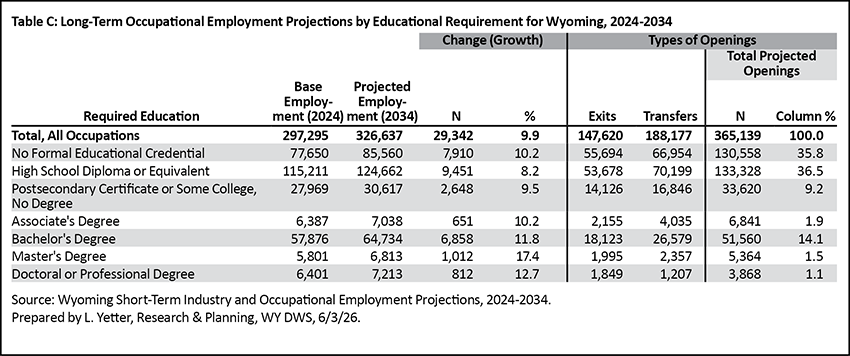
Projected growth or decline is a small component of total openings. In addition to the 29,342 job openings due to growth, Wyoming is projected to have 147,620 openings due to exits and 188,177 openings due to transfers, or 365,139 total openings.
Table B shows the 10 occupations with the greatest total projected openings from 2024 to 2034. Many of the top 10 in this table are relatively low-paying jobs with high rates of turnover. For example, fast food & counter workers is projected to grow by 817 jobs, along with 7,632 openings due to exits and 9,058 openings due to transfers, with a total of 17,507 openings over the next 10 years. Other examples of these types of occupations include retail salespersons (14,735 total openings), stockers & order fillers (9,099), and waiters & waitresses (8,211). Interestingly, cashiers is projected to have the third highest number of total openings (10,116), despite a projected decline of 110 positions from 2024 to 2034. This could be an indication that Wyoming has an abundance of cashier positions that continuously need to be filled without adding new positions.
Of the top 10 occupations with the greatest number of total projected openings, only two require any education beyond a high school diploma. Heavy & tractor-trailer truck drivers requires a postsecondary non-degree award (certificate), and is projected to have 8,345 total openings. General & operations managers requires a bachelor's degree and is projected to have 6,726 total openings. A broader list containing the top 100 occupations by the greatest number of total projected openings is available by clicking here.
As shown in Table C and Figure 2, nearly three in every four (72.3%) of the 365,139 total projected openings require a high school diploma or less. Occupations requiring a bachelor's degree account for 14.1% of the total projected openings, followed by 9.2% that require a post-secondary non-degree award, or some college, no degree. The remaining occupations require an associate's degree (1.9%), master's degree (1.5%), or doctoral or professional degree (1.1%).
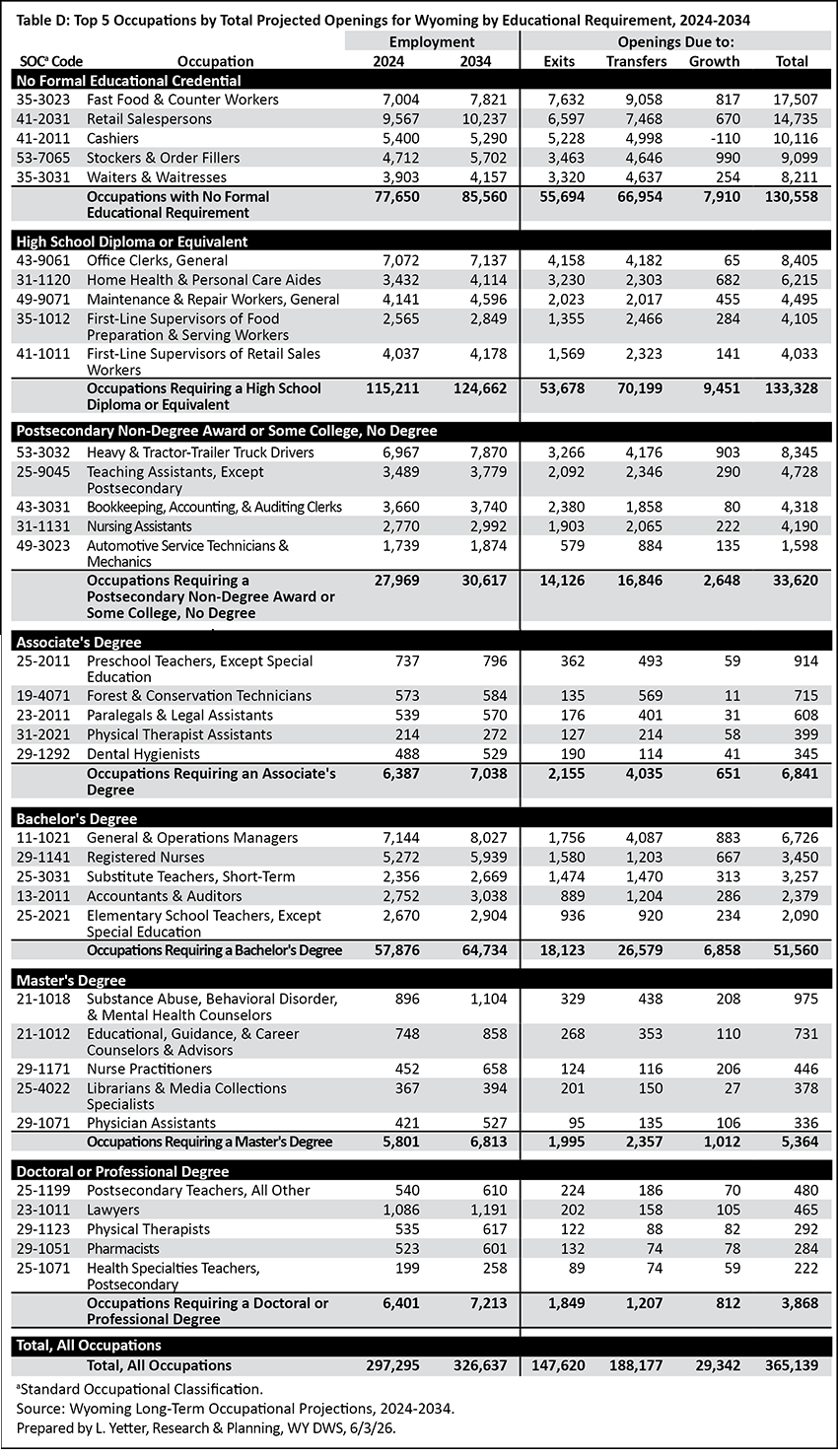
Table D shows the top five occupations by total projected openings for each type of educational requirement. Occupations with no formal educational requirement make up more than one in three (35.8%) total job openings. The occupations with the greatest projected openings in this group include fast food & counter workers (17,507), retail salespersons (14,735), cashiers (10,116), and stockers & order fillers (9,099).
Occupations requiring a high school diploma or equivalent account for the largest proportion of total openings (36.5%). The greatest projected openings can be seen in occupations such as office clerks, general (8,405); home health & personal care aides (6,215); and maintenance & repair workers, general (4,495).
Occupations requiring a post-secondary non-degree award or some college, no degree, make up nearly one in 10 (9.2%) total projected openings. Of the 33,620 projected openings in this group, nearly one in four (8,345) are heavy & tractor-trailer truck drivers. Other occupations requiring a post-secondary certificate or some college that have relatively large numbers of total projected openings include teaching assistants, except post-secondary (4,728); bookkeeping, accounting, & auditing clerks (4,318); and nursing assistants (4,190).
Occupations requiring an associate's degree account for 1.9% of total projected openings. The occupations with the greatest number of projected openings are preschool teachers, except special education (914); forest & conservation technicians (715), and paralegals & legal assistants (608).
Occupations requiring a bachelor's degree make up the greatest proportion of all occupations that require some post-secondary education, and account for 14.1% of all projected openings. General & operations managers show the greatest number of projected openings (6,726), followed by registered nurses (3,450) and short-term substitute teachers (3,257).
Occupations requiring a master's degree account for 1.5% of total projected openings. The occupations with the greatest projected openings are substance abuse, behavioral disorder, & mental health counselors (975); educational, guidance, school, & vocational counselors (731); and nurse practitioners (446).
Finally, occupations requiring a doctoral or professional degree represent the fewest projected openings (3,868) of all educational groups and make up 1.1% of all projected openings. Postsecondary teachers, all other have the greatest number of projected openings (480), followed by lawyers (465) and physical therapists (292).
Occupational projections also make it possible to look at job growth openings by the type of training typically required to enter that job. As an example, Table E shows the top five occupations that require an apprenticeship with the greatest number of total openings. All of these occupations require a high school diploma or equivalent. In total, Wyoming is projected to have 9,047 total openings in occupations requiring an apprenticeship over the next 10 years. The occupations with the greatest number of total openings are electricians (3,487), carpenters (2,869), and plumbers, pipefitters, & steamfitters (1,386).

 Hire Wyo