Wyoming Labor Force Trends
April 2026 | Volume 63, No. 4
Click Here for PDF
Return to Table of Contents
Results of the 2024 Survey of Occupational Injuries and Illnesses
by: Chris McGrath, Senior Statistician
This article summarizes the results from the 2024 Wyoming Survey of Occupational Injuries and Illnesses. The data include estimates of incidence rates by industry and the nature of the injury or illness. Worker demographics – such as age, sex, and occupation, along with case characteristics of event or exposure, source, and nature of injuries and illnesses – are also covered for survey years 2023-2024. An estimated 2,800 nonfatal occupational injury and illness cases with days away from work occurred in private industry in Wyoming in 2024, with an incidence rate of 2.5 per 100 workers (note: this excludes farms with fewer than 11 employees).
Each year the Research & Planning (R&P) section of the Wyoming Department of Workforce Services conducts the Survey of Occupational Injuries and Illnesses (SOII) for Wyoming in cooperation with the U.S. Bureau of Labor Statistics (BLS) as part of a nationwide data collection effort to help measure the effectiveness of governmental efforts to reduce the number of work-related injuries and illnesses. The survey data identify incidence rates of work-related injuries and illnesses at the industry level, as well as detailed case characteristics of severe injuries and illnesses that result in days away from work and days of job transfer or restriction. Beginning with survey years 2021-2022, biennial estimates for days away from work and days of job transfer or restriction by detailed case characteristics and worker demographics are published every two years. The goal of this expansion is to provide a more comprehensive view of how workplace injuries and illnesses are managed.
The data collected for the cases with lost time, which include days away from work and days of job transfer or restriction, can be used by employers and safety awareness groups to focus on prevention. The data are also used by regulatory agencies for tracking injury and illness trends, and to target safety resources.
Wyoming had an estimated 2,800 occupational injury and illness cases with days away from work and days of job transfer or restriction in private industry in 2024, and 2,600 in 2023.
Background and Methodology
The Occupational Injuries and Illnesses form is a mandatory survey that was sent out in January 2025. Wyoming employers were notified of their required participation in early 2024 and asked to maintain a log and summary of work-related injuries and illnesses using the OSHA 300 form and supplementary record with the 301 form. The data collection periods lasted approximately seven months; after which data and results were reviewed by state, regional, and national BLS staff and incidence rates were calculated.
Data were reported by employers on the basis of a single incident or occurrence. If an employee experienced more than one nonfatal work-related injury or illness during the calendar year, each incident was reported separately and is referred to as a case. If an incident injured more than one employee, each employee was reported separately on the questionnaire. For a work-related injury/illness to be categorized as a recordable case, it needs to include at least one of the following elements:
- Death
- Days away from work
- Restricted work or transfer to another job
- Medical treatment beyond first aid
- Loss of consciousness
- A significant injury or illness diagnosed by a physician or other licensed health care professional, even if it does not result in death, days away from work, restricted work or job transfer, medical treatment beyond first aid, or loss of consciousness.
For additional information, see the OSHA Recordkeeping Rules online at https://tinyurl.com/cn6ylt.
Incidence Rates
Incidence rates by industry indicate the number of nonfatal occupational illnesses or injuries per 100 full-time employees. The cases deemed the most serious are those which involve days away from work and days of job transfer or restriction. The BLS counts up to a cap of 180 days away from work per case, even though there are cases with more days. Days away from work cases associated with employees who do not require time off from work beyond the day of injury are not included as days away from work cases. Other recordable cases are also counted in the summary of injuries and/or illnesses, which are cases requiring medical treatment beyond first aid but with no lost time, restricted duty, or job transfer days.
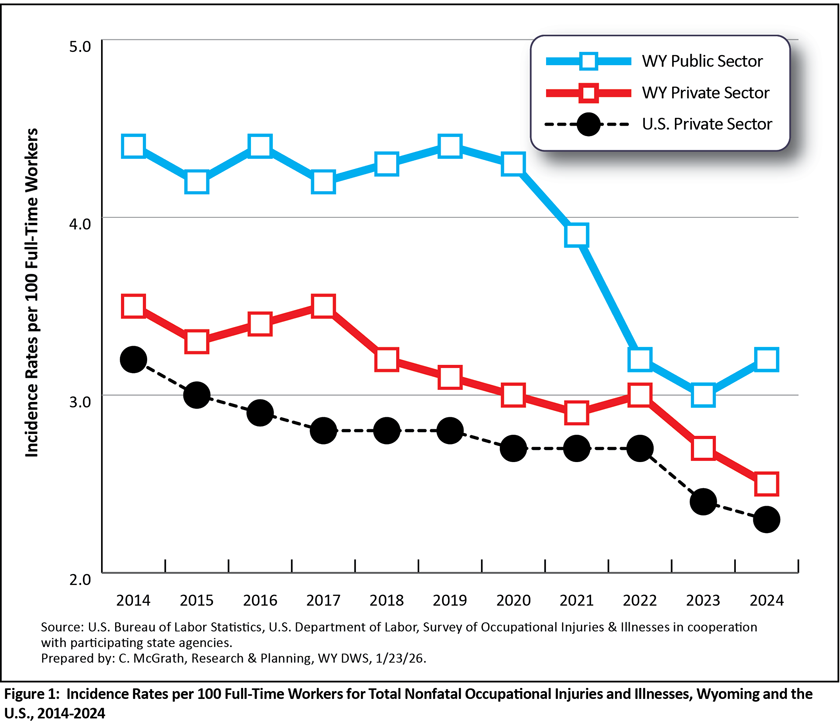
Figure 1 compares incidence rates for all United States private sector, and Wyoming private and public sectors. Private industry encompasses both the goods-producing and service-providing sectors. The incidence rate for the U.S. private sector in 2024 was 2.3 and 2.5 for Wyoming's private sector. The public sector in Wyoming, which comprises state and local government, had an incidence rate of 3.2 in 2024 and 3.0 in 2023.
Survey of Occupational Injuries & Illnesses (SOII) for Wyoming
Now Online
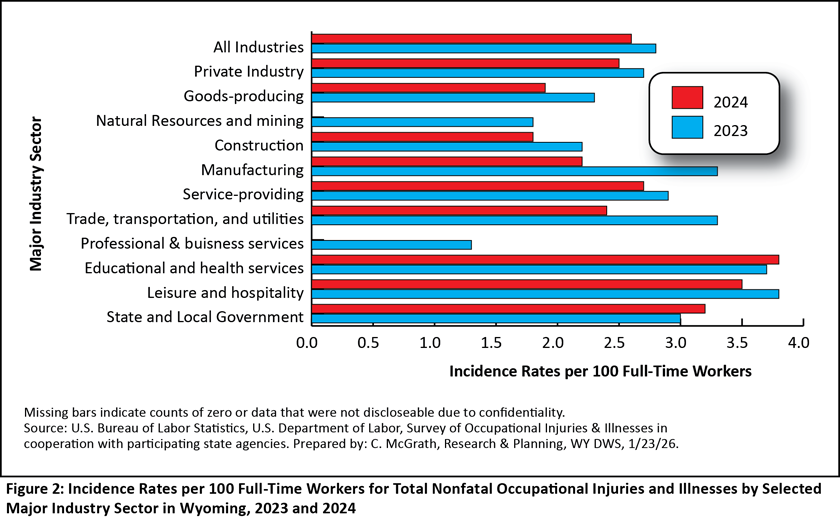
Figure 2 shows incidence rates for total nonfatal occupational injuries and illnesses by major industry sector in Wyoming for 2023 and 2024. The total estimated incidence rate in Wyoming for all industries, including public, was 2.6 in 2024 whereas the incidence rate in 2023 was 2.8. Wyoming had an incidence rate of 2.5 in private industry in 2024 and an incidence rate of 2.7 in 2023. In 2024, manufacturing had an incidence rate of 2.2, while construction had an incidence rate of 1.8. In service-providing sectors, educational and health services had an incidence rate of 3.8 in 2024 and 3.7 in 2023. Leisure and hospitality had an incidence rate of 3.5 in 2024 compared to 3.8 in 2023.
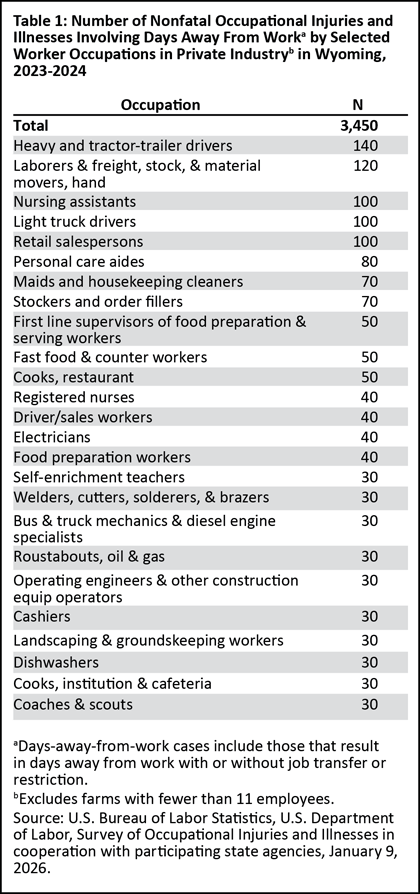
Table 1 displays the number of nonfatal occupational injuries and illnesses involving days away from work by worker occupation in 2023-2024. Heavy and tractor-trailer truck drivers had 140 injuries and illnesses, followed by laborers and freight, stock, and material movers with 120. Nursing assistants and personal care aides, both health care-related occupations, had 100 and 80 injuries and illnesses, respectively. The full table including data by industry is available online.
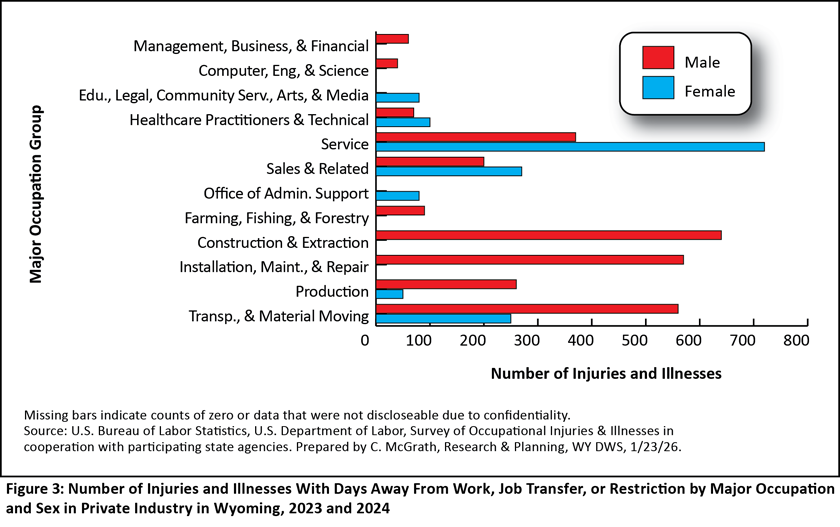
Figure 3 illustrates the number of injuries and illnesses by major occupation and sex in private industry in 2023 & 2024. The SOII collects occupational information based on the Standard Occupational Classification (SOC) codes; the SOC system is used by federal statistical agencies to classify workers into occupational categories (BLS, 2000).
Females working in private service-related occupations had 720 injuries in 2023-2024. Sales and related occupations had 270 injuries and illnesses. Service-related occupations include cooks, servers, maintenance workers, and protective service workers. For males, the construction and extraction occupation had 640 injuries and illnesses in 2023-2024 and installation, maintenance, and repair had 570.
Case Characteristics
Each nonfatal occupational injury and illness is profiled and summarized in four case characteristics: nature of injury or illness, part of body affected, source of injury or illness, and event or exposure of injury or illness. This detailed examination of each injury or illness helps organizations and those responsible for workplace safety identify and correct hazards in the workplace. It also assists in determining what additional measures or safety training need to be added to improve what is already in place.
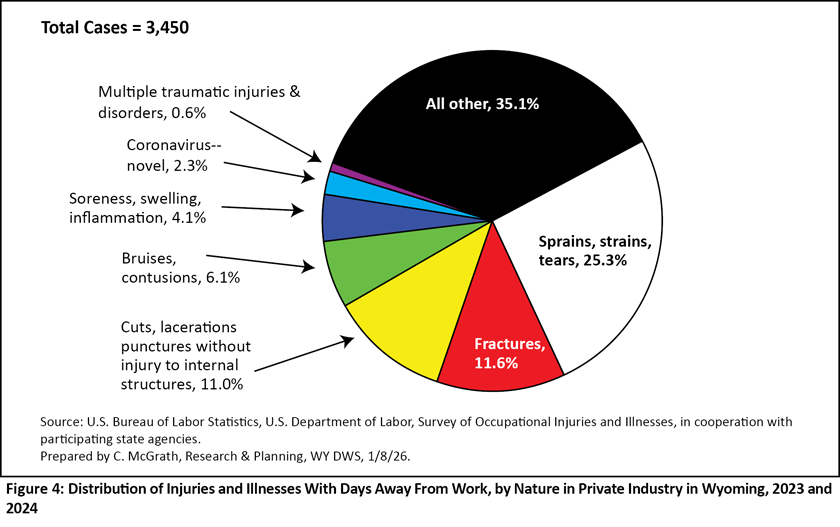
The nature of injury or illness is the physical characteristics of the disabling injury or illness, such as cuts, fractures, or sprains (BLS, 2023). Figure 4 shows in 2023-2024, 25.3% (850) of private industry’s 3,450 total cases of nonfatal occupational injuries resulted in sprains, strains, or tears, and 11.6% (400) was due to fractures. Cuts, lacerations, punctures without injury to internal structures accounted for 11.0% of the nature of injury.
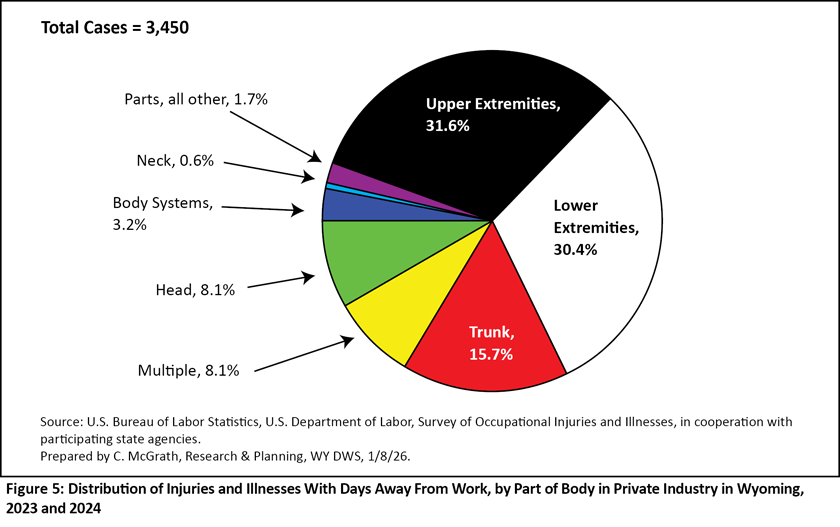
The part of the body is directly linked to the nature of injury or illness cited, such as back, finger, or eye. Figure 5 shows that upper extremities was the part of body most affected in the private sector in 2023-2024, with 1,090 injuries, or 31.6% of the total 3,450 cases. The category titled upper extremities includes the elbow, arm, wrist, fingers, hand, and shoulder. Lower extremities, which include legs, feet, toes, ankles, and knees, recorded 1,050 (30.4%) injuries in 2023-2024.
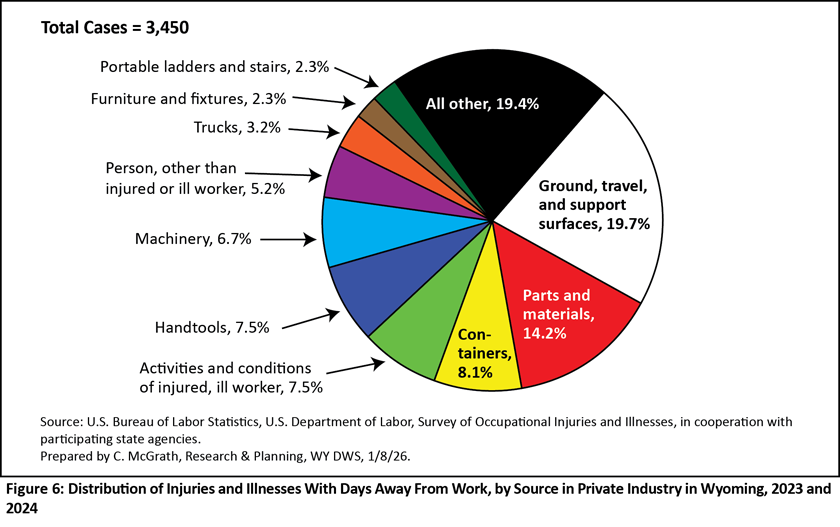
The source of a nonfatal occupational injury or illness is the object, substance, exposure, or bodily motion that directly caused the disabling condition, such as chemical, vehicle, or machinery (BLS, 2023). Figure 6 shows the distribution of injuries and illnesses by source for private industry in Wyoming in 2023-2024. Of the 3,450 total cases, ground, travel, and support surfaces was the source for 19.7% (680) of the cases. Parts and materials had 490 cases, or 14.2%. If an employee was injured when slipping on ice in a parking lot or sidewalk, the source would be the parking lot or sidewalk, and would be included in the category ground, travel, and support surfaces.
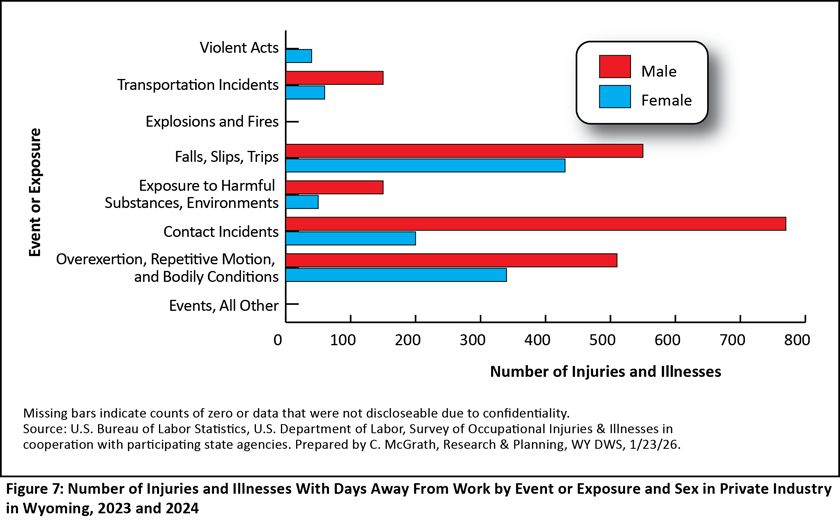
The event or exposure in a case is the manner in which the injury or illness was produced or inflicted, such as falls, overexertion, or repetitive motion (BLS, 2023). Figure 7 shows that in 2023-2024, contact incidents (770) was high for cases by event or exposure for males and cases due to falls, slips, trips (430) was high for females. Falls, slips, trips accounted for 550 cases for males and overexertion, repetitive motion, and bodily conditions accounted for 340 for females.
An example of an injury or illness that would be produced by overexertion, repetitive motion, and bodily reaction would be a job that required excessive amounts of physical exertion, such as standing, climbing, kneeling, bending, or stepping, which resulted in the injury or illness. Falls, slips, trips is a much broader category and includes falls on the same level or falls and jumps to lower levels; slips, trips on uneven surfaces; or a substance, hole, etc. Injuries or illnesses inflicted in contact with object, equipment category are a result of contact between the injured person and the source. Examples would be an employee being cut by a slipping knife or an employee caught under collapsing material.
Summary
From 2023 to 2024, incidence rates of work-related injuries and illnesses in all industries in Wyoming went from 2.8 to 2.6. Overall, males experience work-related injuries and illnesses more than females. This was likely due, in part, to higher ratios of males to females employed in industries with higher incidence rates. More details on 2023-2024 data, as well as further documentation and historical data are available at http://doe.state.wy.us/LMI/OSH/toc.htm.
References
U.S. Bureau of Labor Statistics. (2000). Standard Occupational Classification. SOC 2000 - user guide. Retrieved January 12, 2026, from https://www.bls.gov/soc/2000/socguide.htm
U.S. Bureau of Labor Statistics. (2023). Occupational Injury and Illness Classification Manual - OIICS Version 3.02. Retrieved January 9, 2026, from https://tinyurl.com/yc7nczjv
Bureau of Labor Statistics. (2026, January). Employer-reported workplace injuries and illnesses, 2023-2024. Economic news release. Retrieved April 8, 2026, from https://www.bls.gov/news.release/osh.nr0.htm
 Hire Wyo