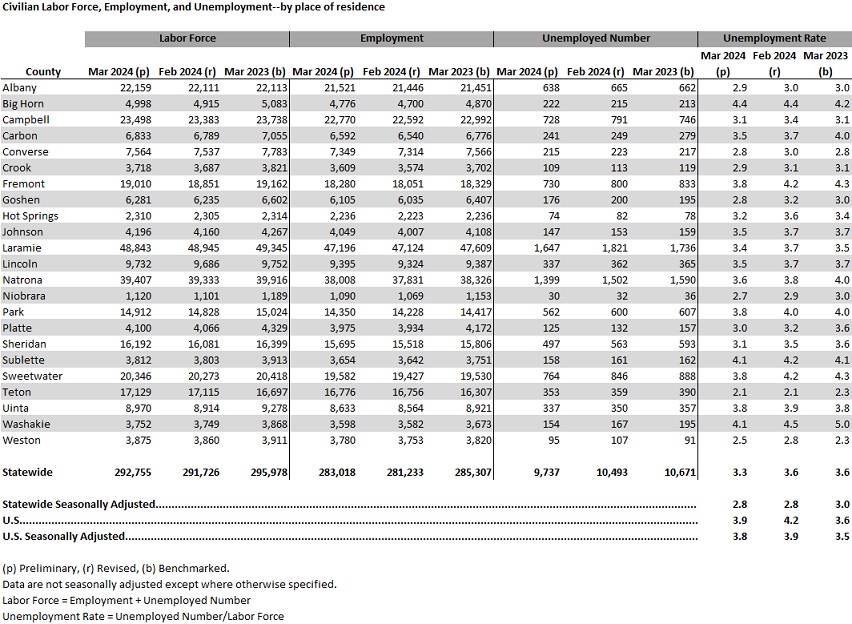
The Research & Planning section of the Wyoming Department of Workforce Services reported today that the state’s seasonally adjusted unemployment rate remained unchanged from July to August at 3.0%. Wyoming’s unemployment rate is somewhat lower than its August 2025 level of 3.3% and much lower than the current U.S. rate of 4.1%.
From July to August, most county jobless rates rose slightly. The largest increases were found in Niobrara (up from 3.1% to 4.0%), Platte (up from 3.0% to 3.5%), Carbon (up from 2.5% to 2.9%), and Hot Springs (up from 2.5% to 2.9%) counties. Fremont County’s unemployment rate fell from 3.5% to 3.4%, and unemployment rates held steady in Sweetwater (3.4%), Converse (2.4%), and Albany (2.2%) counties.
Compared to a year earlier, unemployment rates rose in eight counties, fell in 14 counties and remained unchanged in Crook County. The largest increases occurred in Johnson (up from 2.2% to 2.5%) and Teton (up from 1.5% to 1.8%) counties. The largest decreases were seen in Goshen (down from 3.4% to 2.8%), Big Horn (down from 3.8% to 3.2%), and Uinta (down from 3.3% to 2.8%) counties.
In August, the lowest unemployment rates were reported in Teton County at 1.8% and Albany County at 2.2%. The highest unemployment rates were found in Niobrara County at 4.0% and Platte County at 3.5%.
Current Employment Statistics (CES) estimates show that total nonfarm employment in Wyoming (not seasonally adjusted and measured by place of work) rose from 300,100 in August 2025 to 300,600 in August 2026, an increase of 500 jobs, or 0.2%.
September unemployment data will be published on October 21, 2026.
Wyoming Seasonally Adjusted Statewide Labor Force Estimates
                                                                                               Change
                                                                                    Month                    Year
                                   August-26       July-26     August-25     absolute     percent    absolute     percent
Total Civilian Labor Force           284,980       285,207       287,825        -227       -0.1%      -2,845       -1.0%
Employed                             276,474       276,564       278,299         -90        0.0%      -1,825       -0.7%
Unemployed                             8,506         8,643         9,526        -137       -1.6%      -1,020      -10.7%
Unemployment Rate                        3.0           3.0           3.3
| Definitions: | |
| Employed | All persons who, during the reference week, did any work at all as paid employees, worked in their own business, profession, or on their own farm, or worked 15 hours or more as unpaid workers in a family business. |
| Unemployed | All persons who had no employment during the reference week, were available for work, and had made specific efforts to find employment sometime during the 4-week period ending with the reference week. |
| Labor Force | All persons who meet the criteria given above as either employed or unemployed. |
| Unemployment Rate | The number of unemployed as a percent of the labor force. |
| Seasonal Adjustment | A statistical procedure to remove the impact of normal regularly recurring events (such as weather, major holidays, and the opening and closing of schools) from economic time series to better understand changes in economic conditions from month to month. |
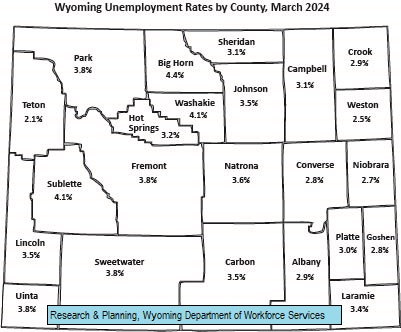
Not seasonally adjusted data reflect the actual economic conditions in a given area for a given time period. These data show the normal seasonal changes that occur in the economy. Most county unemployment rates are higher in the winter months because of seasonal job losses in construction, leisure & hospitality, and many other sectors. Similarly, most county unemployment rates are lower in the summer months as employment increases across the economy. Data users should use caution when comparing not seasonally adjusted data for different months, as at least part of the difference between months may reflect normal seasonal patterns.
In contrast, seasonally adjusted data have been subjected to a statistical procedure to remove the effects of normal changes that occur in the economy each year, such as seasonal hiring in the construction sector, the opening and closing of schools, and holiday hiring by retail trade establishments. There is no expectation that seasonally adjusted unemployment rates will be higher or lower in any particular month, except as the economy expands or contracts. The value of seasonally adjusted data is that it is easy to identify longer-term trends in the data and valid comparisons can be made between any two months in the series.
Research & Planning works in cooperation with the Bureau of Labor Statistics to develop and publish unemployment rates for each county in Wyoming. However, these data are not seasonally adjusted and therefore reflect seasonal changes each month.
Table 1: Wyoming counties not seasonally adjusted unemployment
rates ranked from lowest to highest for August 2026


   County                           Rate*
Teton County, WY                     1.8
Albany County, WY                    2.2
Converse County, WY                  2.4
Crook County, WY                     2.4
Lincoln County, WY                   2.4
Johnson County, WY                   2.5
Sheridan County, WY                  2.5
Park County, WY                      2.6
Sublette County, WY                  2.6
Campbell County, WY                  2.7
Weston County, WY                    2.7
Wyoming                              2.7
Goshen County, WY                    2.8
Natrona County, WY                   2.8
Uinta County, WY                     2.8
Carbon County, WY                    2.9
Hot Springs County, WY               2.9
Laramie County, WY                   2.9
Washakie County, WY                  3.0
Big Horn County, WY                  3.2
Fremont County, WY                   3.4
Sweetwater County, WY                3.4
Platte County, WY                    3.5
Niobrara County, WY                  4.0

*preliminary
Table 2: Wyoming counties not seasonally adjusted unemployment rates over-the-month
rate changes ranked from lowest to highest August 2026

                                  Month ago               Over-the-Month
   County                           Rate         Rate*     Rate Change
Fremont County, WY                   3.5          3.4         -0.1
Albany County, WY                    2.2          2.2          0.0
Converse County, WY                  2.4          2.4          0.0
Sweetwater County, WY                3.4          3.4          0.0
Park County, WY                      2.5          2.6          0.1
Sheridan County, WY                  2.4          2.5          0.1
Wyoming                              2.6          2.7          0.1
Big Horn County, WY                  3.0          3.2          0.2
Campbell County, WY                  2.5          2.7          0.2
Crook County, WY                     2.2          2.4          0.2
Goshen County, WY                    2.6          2.8          0.2
Johnson County, WY                   2.3          2.5          0.2
Lincoln County, WY                   2.2          2.4          0.2
Natrona County, WY                   2.6          2.8          0.2
Teton County, WY                     1.6          1.8          0.2
Laramie County, WY                   2.6          2.9          0.3
Sublette County, WY                  2.3          2.6          0.3
Uinta County, WY                     2.5          2.8          0.3
Washakie County, WY                  2.7          3.0          0.3
Weston County, WY                    2.4          2.7          0.3
Carbon County, WY                    2.5          2.9          0.4
Hot Springs County, WY               2.5          2.9          0.4
Platte County, WY                    3.0          3.5          0.5
Niobrara County, WY                  3.1          4.0          0.9

*preliminary
Table 3: Wyoming counties not seasonally adjusted unemployment rates over-the-year
changes ranked from lowest to highest for August 2026

                                  Year ago                Over-the-Year
   County                           Rate         Rate*     Rate Change
Big Horn County, WY                  3.8          3.2         -0.6
Goshen County, WY                    3.4          2.8         -0.6
Uinta County, WY                     3.3          2.8         -0.5
Carbon County, WY                    3.3          2.9         -0.4
Converse County, WY                  2.8          2.4         -0.4
Hot Springs County, WY               3.3          2.9         -0.4
Platte County, WY                    3.8          3.5         -0.3
Albany County, WY                    2.4          2.2         -0.2
Sublette County, WY                  2.8          2.6         -0.2
Laramie County, WY                   3.0          2.9         -0.1
Natrona County, WY                   2.9          2.8         -0.1
Park County, WY                      2.7          2.6         -0.1
Sheridan County, WY                  2.6          2.5         -0.1
Washakie County, WY                  3.1          3.0         -0.1
Wyoming                              2.8          2.7         -0.1
Crook County, WY                     2.4          2.4          0.0
Campbell County, WY                  2.6          2.7          0.1
Fremont County, WY                   3.3          3.4          0.1
Lincoln County, WY                   2.3          2.4          0.1
Sweetwater County, WY                3.3          3.4          0.1
Weston County, WY                    2.6          2.7          0.1
Niobrara County, WY                  3.8          4.0          0.2
Johnson County, WY                   2.2          2.5          0.3
Teton County, WY                     1.5          1.8          0.3

*preliminary
|
Wyoming Department of Workforce Services Research & Planning September 21, 2026 Contacts: David Bullard, Senior Economist, 307-473-3810 Carola Cowan, BLS Programs Supervisor, 307-473-3804 |