Wyoming Survey of Occupational Injuries and Illnesses Incidence Rate Decreases
for Private Industry in 2011
The
Research & Planning Section of the Wyoming Department of Workforce Services
reports that Wyoming’s nonfatal occupational injuries and illnesses estimated
private industry incidence rate for 2011 was 3.6 per 100 full-time employees
(n=7,459). This was 0.4 lower than last year’s rate (n=8,216), according to
the Survey of Occupational Injuries and Illnesses in cooperation with the Bureau
of Labor Statistics.
Total
goods-producing sectors had an injury and illness incidence rate of 3.5
(see Table). Injury and illness incidence rates among these sectors in 2011
ranged from 2.2 in mining to 8.6 in agriculture, forestry, fishing, &
hunting.
The
service-providing sectors (such as retail trade and transportation &
warehousing) had an incidence rate of 3.7 per 100 full-time workers in 2011.
Rates among these sectors went from a high of 5.4 in health care & social
assistance to a low of 3.3 in both wholesale trade and educational services. All
of the selected sectors had decreased incidence rates from 2010.
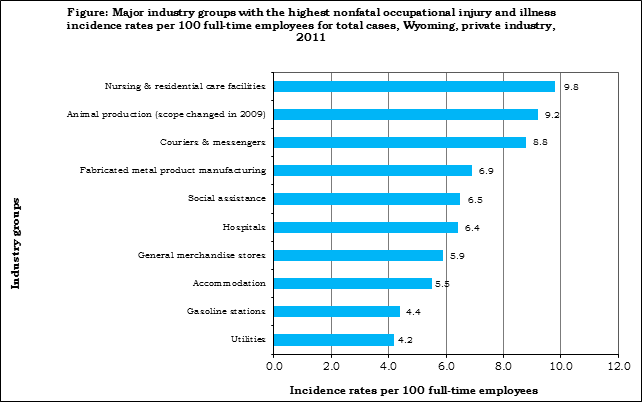
Among
detailed industries, nursing & residential care facilities had the highest
incidence rate in 2011 at 9.8 (see Figure). The total number of employees in
nursing & residential care facilities was estimated at 4,500, which had 441
occupational injury or illness cases. The next two higher incidence rates were
in animal production at 9.2 (out of 800 employees; an estimated 74 cases) and
couriers & messengers at 8.8 (out of 800 employees; 70 cases).
These
estimates are all recordable occupational injuries and illnesses which include:
days away from work cases, days of job transfer or restriction cases; and other
recordable cases. Nonrecordable cases include but are not limited to first aid
cases, such as a bandage on a cut, or a water flush of an eye to remove a
foreign object; further information on recordable cases can be found at: http://data.bls.gov/iif/oshdef.htm.
For
additional information about occupational injuries and illnesses in Wyoming, see
http://doe.state.wy.us/LMI/OSH/toc.htm.
Source:
Bureau of Labor Statistics, U.S. Department of Labor, Survey of Occupational
Injuries and
Illnesses in cooperation with Participating state agencies.
| Total
Private Industry5 |
205.4 |
4.0 |
207.2 |
3.6 |
| Goods-Producing5 |
57.3 |
3.6 |
58.0 |
3.5 |
| Agriculture,
forestry, fishing, & hunting (11) |
-- |
-- |
1.2 |
8.6 |
| Mining6
(21) |
24.1 |
2.0 |
26.2 |
2.2 |
| Construction
(23) |
23.4 |
4.5 |
21.7 |
4.0 |
| Manufacturing
(31-33) |
8.7 |
5.8 |
8.9 |
5.8 |
| Service-Providing |
148.1 |
4.1 |
149.2 |
3.7 |
| Wholesale
trade (42) |
8.6 |
4.0 |
8.7 |
3.3 |
| Retail
trade (44-45) |
29.8 |
4.4 |
29.3 |
4.0 |
| Transportation
& warehousing7
(48-49) |
8.7 |
4.7 |
9.2 |
4.4 |
| Utilities
(22) |
2.5 |
5.4 |
2.5 |
4.2 |
| Educational
services (61) |
1.8 |
3.8 |
1.8 |
3.3 |
| Health
care & social assistance (62) |
23.2 |
5.6 |
23.7 |
5.4 |
| Accommodation
& food services (72) |
29.7 |
4.4 |
30.0 |
4.3 |
| |
|
|
|
|
| 1
Incidence rates represent the number of injuries and illnesses per
100 full-time workers and were calculated as: (N/EH) x 200,000 where |
|
N
= number of injuries and illnesses. |
|
EH
= total hours worked by all employees during the calendar
year. |
|
200,000
= base for 100 equivalent full-time workers (working 40 hours
per week, 50 weeks per year). |
| 2
Totals include data for industries not shown separately. |
| 3
North American Industry Classification
System 2007 Edition. |
| 4
Employment is expressed as an annual average and is derived from the
BLS-State Quarterly Census of Employment and Wages. |
| 5
Excludes farms with fewer than 11 employees. |
| 6
Data for mining (Sector 21 in the North
American Industry Classification System
-- United States, 2007) include establishments not governed by the
Mine Safety and Health Administration (MSHA) rules and reporting,
such as those in oil and gas extraction and related support
activities. Data for mining operators in coal, metal, and nonmetal
mining are provided to BLS by the Mine Safety and Health
Administration, U.S. Department of Labor. Independent mining con- |
| tractors
are excluded from the coal, metal, and nonmetal mining industries.
These data do not reflect the changes the Occupational Safety and
Health Administration made to its recordkeeping requirements
effective January 1, 2002; therefore estimates for these industries
are not comparable to estimates in other industries. |
| 7
Data for employers in rail transportation are provided to BLS by the
Federal Railroad Administration, U.S. Department of Transportation. |
| |
| NOTE:
Because of rounding, components may not add to totals. Dash
indicates data that do not meet publication guidelines. |
| |
| SOURCE:
Bureau of Labor Statistics, U.S. Department of Labor, Survey of
Occupational Injuries and Illnesses, in cooperation with
participating State agencies. |
| |
| Table
created by Valerie A. Davis, Senior Statistician, Research &
Planning, Wyoming Department of Workforce Services. |
|
Table of
Contents | Labor Market Information